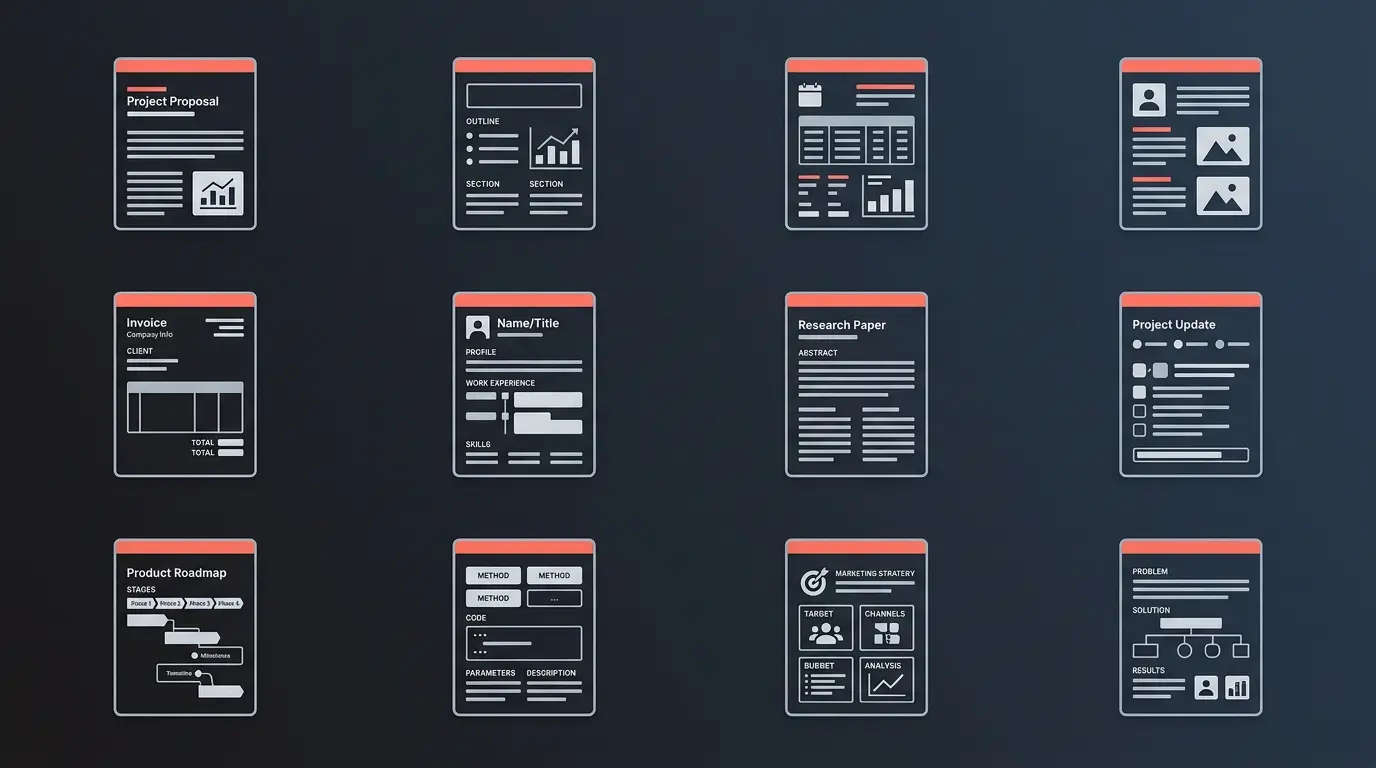
Every blog post has an ideal structure. A how-to guide needs numbered steps. A comparison needs a feature table. A case study needs a results section. Claude Blog ships with 12 content templates that handle this structural thinking for you, so every article starts with the right framework for its content type.
This guide explains each template: what it is, when to use it, typical word count, and the key structural elements that make it work. You can specify any template with the --template flag in the /blog write command.
1. How-to template
What it is: Step-by-step instructional guides that walk readers through a specific process from start to finish.
When to use it: Any time you are teaching someone to do something. Installation guides, configuration walkthroughs, workflow tutorials, and process documentation all fit this template.
Coverage guidance: Match the reader's intent and the evidence required. Do not pad the article to a fixed length.
Key structural elements: Introduction with prerequisites, numbered steps with clear headings, code blocks or screenshots for technical topics, troubleshooting section, and a summary of what was accomplished.
2. Listicle template
What it is: Numbered lists of items, tips, tools, or resources organized around a central theme.
When to use it: Curated collections, "top N" roundups, tips and tricks articles, and resource compilations. Listicles are one of the most shareable content formats and perform well in search.
Coverage guidance: Match the reader's intent and the evidence required. Do not pad the article to a fixed length.
Key structural elements: Brief introduction, numbered items with H2 or H3 headings, consistent structure per item (description, benefit, example), and a conclusion with recommendations.
3. Comparison template
What it is: Side-by-side analysis of two or more products, tools, approaches, or strategies.
When to use it: "X vs Y" articles, tool comparisons, methodology evaluations, and decision guides. Comparison content targets high-intent search queries from readers ready to make a choice.
Coverage guidance: Match the reader's intent and the evidence required. Do not pad the article to a fixed length.
Key structural elements: Feature comparison table, individual sections for each option, pricing breakdown, use case recommendations ("choose X if..."), and a clear verdict or summary.
4. Case study template
What it is: Real-world examples documenting a specific situation, the approach taken, and the measurable results achieved.
When to use it: Client success stories, project retrospectives, experiment results, and before/after analyses. Case studies build trust through concrete evidence.
Coverage guidance: Match the reader's intent and the evidence required. Do not pad the article to a fixed length.
Key structural elements: Background/context, challenge description, solution approach, implementation details, results with specific metrics, and key takeaways.
5. Pillar page template
What it is: Comprehensive topic hubs that cover a broad subject in depth and link to related subtopic articles.
When to use it: Building topical authority around core themes. Pillar pages serve as the central hub in a topic cluster strategy, linking to and from 5-15 related articles.
Coverage guidance: Match the reader's intent and the evidence required. Do not pad the article to a fixed length.
Key structural elements: Table of contents, broad topic overview, multiple H2 sections covering subtopics, internal links to cluster articles, summary section, and resource list.
6. News/trend template
What it is: Timely analysis of industry developments, emerging trends, product launches, and market shifts.
When to use it: Breaking news coverage, quarterly trend reports, product announcement analysis, and industry predictions. Time-sensitive content that needs to publish quickly.
Coverage guidance: Match the reader's intent and the evidence required. Do not pad the article to a fixed length.
Key structural elements: Lead paragraph with the key news, context and background, analysis of implications, expert commentary or data, and a forward-looking conclusion.
7. Opinion/thought leadership template
What it is: Expert perspectives and arguments backed by data, experience, and industry knowledge.
When to use it: Establishing authority on a topic, challenging conventional wisdom, presenting a unique perspective, or advocating for a specific approach. Strong E-E-A-T content.
Coverage guidance: Match the reader's intent and the evidence required. Do not pad the article to a fixed length.
Key structural elements: Clear thesis statement, supporting arguments with evidence, counterargument acknowledgment, author credentials, and a call to action or conclusion.
8. Product review template
What it is: In-depth analysis of a specific product or service with hands-on evaluation.
When to use it: Software reviews, tool evaluations, book reviews, and service assessments. Review content targets "review" and "is X worth it" search queries.
Coverage guidance: Match the reader's intent and the evidence required. Do not pad the article to a fixed length.
Key structural elements: Product overview, feature breakdown, pros and cons list, pricing analysis, comparison with alternatives, verdict with rating, and recommended use cases.
9. FAQ/Q&A template
What it is: Question-and-answer format articles targeting specific queries and featured snippet opportunities.
When to use it: Addressing a genuine set of related customer questions or creating support content. Use this format for reader value, not as an AI-citation or rich-result shortcut.
Coverage guidance: Match the reader's intent and the evidence required. Do not pad the article to a fixed length.
Key structural elements: Genuine questions, complete answers, supporting detail where useful, and optional FAQPage markup only when it matches visible content.
10. Tutorial template
What it is: Technical walkthroughs with code examples, configurations, and detailed implementation instructions.
When to use it: Developer-focused content, technical documentation, API integration guides, and coding tutorials. More technical than how-to guides.
Coverage guidance: Match the reader's intent and the evidence required. Do not pad the article to a fixed length.
Key structural elements: Prerequisites section, environment setup, step-by-step code blocks, expected output examples, error handling, and a working demo or repository link.
11. Resource roundup template
What it is: Curated collections of tools, links, books, courses, or references organized by category.
When to use it: "Best tools for X" articles, resource libraries, reading lists, and link collections. Resource content attracts backlinks and social shares.
Coverage guidance: Match the reader's intent and the evidence required. Do not pad the article to a fixed length.
Key structural elements: Category headings, consistent entry format (name, description, link, key feature), comparison notes, and selection criteria explanation.
12. Data-driven template
What it is: Research-heavy articles built around statistics, surveys, experiments, and data analysis.
When to use it: Original research, industry benchmarks, survey results, A/B test reports, and data analysis articles. Data-driven content earns the most citations from AI platforms.
Coverage guidance: Match the reader's intent and the evidence required. Do not pad the article to a fixed length.
Key structural elements: Methodology section, data tables and charts, key findings highlighted, statistical context, limitations disclosure, and a conclusions section with actionable insights.
Template selection summary
| Template | Word Count | Best For |
|---|---|---|
| How-to | 1,500-2,500 | Teaching processes |
| Listicle | 1,200-2,000 | Curated collections |
| Comparison | 1,500-2,500 | X vs Y decisions |
| Case study | 1,500-2,000 | Proving results |
| Pillar page | 3,000-5,000 | Topical authority |
| News/trend | 800-1,200 | Timely analysis |
| Opinion | 1,200-2,000 | Thought leadership |
| Product review | 1,500-2,500 | Tool evaluations |
| FAQ/Q&A | 1,000-1,800 | Featured snippets |
| Tutorial | 2,000-3,000 | Technical guides |
| Resource roundup | 1,500-2,500 | Link collections |
| Data-driven | 2,000-3,500 | Original research |
Template selection changes the structure, not a required word count. A short complete article can remain short, while complex research can expand as needed.
If you do not specify a template, Claude Blog auto-selects the best match based on your topic. For manual selection, use /blog write "topic" --template comparison.