Read the transcript
In August 2026, Anthropic started adding an invisible watermark to the text that Claude generates. It is based on Google DeepMind's SynthID, and it works by nudging the model's word choices into a pattern that only shows up if you hold the secret key. You cannot see it, and it does not change how the writing reads. Why now? The European Union's AI Act made machine readable marking of AI content mandatory from August 2026, with fines that reach into the millions, and nearly every major AI company has signed on. So what does this mean if you use AI for content? Less than the panic suggests. Google still ranks pages on quality, not on whether a machine helped write them. The watermark says nothing about who owns the work, and there is no public detector yet. It survives copy and paste and light edits, but a genuine rewrite in your own voice removes it. That real human editing is exactly what the law rewards and what readers trust. The takeaway is simple. Keep AI in the drafting seat, keep a human in the editor's chair, and let quality carry the page. Provenance is becoming infrastructure. Quality is still the product.
Key Takeaways
• AI watermarking is now default infrastructure: Google marks output across its products, Anthropic marks Claude's text, and detection surfaces are coming to Search and Chrome.
• Watermarks change disclosure and platform labeling, not Google's quality rules. Content is still judged on quality and E-E-A-T, not production method.
• Workflows with real human editing behave differently from publish-raw workflows: heavy editing removes the signal, and the EU AI Act exempts human-reviewed text.
Anthropic has started adding an invisible, machine-readable watermark to text generated by Claude, using technology adapted from Google DeepMind's SynthID-Text. If AI is part of your content workflow, this matters. Major AI providers are making generated text easier to identify, the EU AI Act has required machine-readable marking since August 2, 2026, and platforms are already labeling AI-generated media. Researched from primary sources on , this guide breaks down what changed, how the watermark works, where it falls short, and what marketing teams should do next.
To be clear, this doesn't mean AI-assisted content will be penalized. Watermarking is about tracing where content came from and whether its use is disclosed, not judging its quality. But there will be a clearer distinction between publishing raw AI output and using AI as part of a genuinely human-led editing process. That difference already matters technically and legally, and soon it may be much easier to measure.
What Anthropic actually shipped
In mid-August 2026, Anthropic announced that Claude's text output now carries a machine-readable watermark. The change applies worldwide, not just in the EU. According to Anthropic's help center, Claude models launched on or after August 2, 2026 support marking at launch, while models launched before that date fall under a legal transition period while marking is added. No user opt-out is documented.
The mechanism is an adaptation of Google DeepMind's SynthID-Text. When Claude chooses among several comparably likely next words, the watermark changes only the source of randomness used for that choice, steering it with a key plus the preceding words. The result reads identically to unwatermarked text, is invisible to readers, and is detectable only with the key. Anthropic reports no impact on quality, speed, or price.
Equally important is what a detection result does not prove. Anthropic is explicit that detection cannot confirm a text was human-written, cannot identify output from other AI systems, cannot distinguish text Claude wrote from text Claude heavily edited, says nothing about ownership or authorship, and identifies nothing about individual users. It answers exactly one question: does this passage carry Claude's statistical signature?
How SynthID-Text works, in plain language
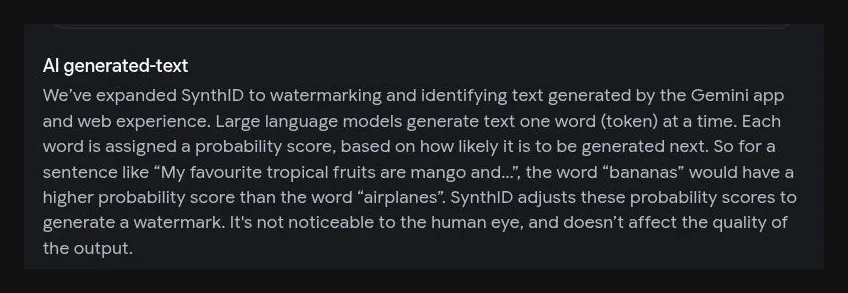
SynthID is Google DeepMind's watermarking family. It covers images, audio, video, and text, and already runs across Google products: text in the Gemini app and on the web, audio from Lyria, and outputs in NotebookLM. For text, SynthID works by adjusting the probability scores of candidate tokens as the model generates.
Skip the math. A language model generates text one word at a time. At many points in a sentence, multiple continuations are nearly equally plausible. For instance, if asked to complete a sentence about a favorite tropical fruit, options like mango, banana, or papaya might all be reasonable. An unwatermarked model selects among these options using standard randomness. A watermarked model also makes a selection, but its randomness is derived from a keyed function of the preceding words. No single word choice gives the watermark away. But across hundreds of words, these subtly biased choices accumulate into a statistical signature. This signature can be detected by someone who holds the key, while remaining invisible to everyone else.
This is not a lab prototype. The method was peer reviewed in Nature in October 2024 as "Scalable watermarking for identifying large language model outputs" (Nature 634, 818-823). The paper includes a live experiment on nearly 20 million Gemini responses, which found no significant difference in user feedback between watermarked and unwatermarked output.
DeepMind also documents the limits. Thorough rewriting or translation defeats the watermark, and factual prompts with little word-choice variation carry a weak signal. A question about the capital of France has one good answer, so there are no comparably likely words for the watermark to work with.
Watermarking is already everywhere
Watermarking sounds like a compliance footnote until you look at the volume Google reports. When the SynthID Detector was announced in May 2025, Google said over 10 billion pieces of content had already been watermarked. By November 2025, the figure was over 20 billion pieces. At Google I/O in May 2026, the keynote cited over one hundred billion images and videos, plus sixty thousand years of audio. Note that the units shift between announcements, so treat these as milestones, not one continuous series.
Why now: the EU AI Act made it mandatory
Article 50(2) of the EU AI Act requires providers of generative AI systems to ensure their outputs are marked in a machine-readable format and detectable as artificially generated, applicable from August 2, 2026. That is the exact date Anthropic uses to split models that mark at launch from models in transition. Non-compliance is expensive: penalties run up to EUR 15 million or 3% of total worldwide annual turnover, whichever is higher.
The Act also contains the clause that matters most for content teams: Article 50 includes an exemption for AI-generated text that has undergone human review and editorial control. European regulators drew a line between raw machine output and edited work that a person takes responsibility for. That distinction should shape your workflow more than the watermark itself.
Industry has moved with the regulation rather than against it. By July 31, 2026, about 190 organizations had signed the EU Code of Practice on Transparency of AI-Generated Content, including Anthropic, Google, Meta, Microsoft, and OpenAI.
SynthID vs C2PA: two different kinds of provenance
Claude actually ships two provenance systems, and they behave differently. Text gets the statistical watermark described above. Files Claude produces, such as .png, .jpg, and .svg exports, instead get C2PA provenance metadata: cryptographically signed, tamper-evident, and attached to the file. Because it sits in metadata rather than in the content itself, it can be stripped.
C2PA is the Coalition for Content Provenance and Authenticity, the open standard behind Content Credentials. Its steering committee includes Adobe, BBC, Google, Intel, Microsoft, OpenAI, Sony, and Truepic, and OpenAI attaches C2PA credentials to DALL-E 3 images. The two approaches compare like this.
| Property | SynthID text watermark | C2PA Content Credentials |
|---|---|---|
| What it is | A statistical pattern in the word choices themselves | Cryptographically signed provenance metadata |
| Where it lives | Inside the content | In the file, alongside the content |
| Survives copy-paste? | Yes, it travels with the text | Only if the file and its metadata travel together |
| Survives screenshot? | In substance, yes: retyping the same words preserves the pattern | No, a screenshot creates a new file without credentials |
| Survives metadata stripping? | Yes, there is no metadata to strip | No, stripping the metadata removes it |
| Who uses it | Google products; Claude text output | Adobe, BBC, Google, Intel, Microsoft, OpenAI, Sony, Truepic; Claude file outputs |
What this means for marketing teams
Google Search does not care how you wrote it
Google's published position is stable: appropriate use of AI is not against its guidelines, and content is judged on quality and E-E-A-T regardless of how it was produced. The red line is scaled content abuse, meaning mass-produced low-value pages created primarily to manipulate rankings. Nothing in the watermark rollout changes that stance. If your AI-assisted pages are useful, original, and edited by someone accountable, the production method is not the ranking variable. Quality is.
Platform labels target media first
Labeling is already routine for images and video. Meta applies AI labels on Facebook, Instagram, and Threads using industry-standard indicators from companies like Google, OpenAI, Microsoft, and Adobe. TikTok requires creators to label realistic AI-generated content and automatically labels media carrying C2PA Content Credentials. YouTube requires disclosure of realistic synthetic content. Automatic labeling of watermarked text has not been deployed on any major platform, but the media precedent shows where the infrastructure is heading.
Consumers punish visible AI, not hidden provenance
AI adoption in marketing is close to universal. HubSpot's 2026 State of Marketing report, based on a survey of more than 1,500 marketers, found that 86.4% of marketing teams use AI in at least a few areas. For content creation specifically, 42.5% use it extensively and another 38% use it occasionally.
Consumers are much less positive about it. A Klaviyo and Datalily survey of 8,000 people across eight countries, conducted in December 2025 and reported by eMarketer, found that visibly AI-generated marketing increases trust for just 7% of consumers. For 31%, it reduces trust. The key word is "visibly." The watermark itself can't be seen; what people react to is content that feels obviously machine-made. The answer isn't to avoid the watermark, it's to edit the content properly.
The limits: what a watermark can and cannot tell you
The watermark is robust to normal reuse but not to real editing. Based on Anthropic's documentation and TechCrunch's reporting on the rollout, the split is simple.
- What tends to survive: copy-paste, because the pattern travels with the text, and light editing, which usually leaves the watermark detectable. Longer passages give higher detection confidence.
- What weakens or removes it: a complete rewrite removes the watermark, heavy human editing leaves little signal, short samples are unreliable to test, factual low-entropy passages carry a sparse signal, and code carries little signal because the watermark attaches mainly to comments.
Independent research points the same direction. ETH Zurich's SRI Lab probed SynthID-Text in December 2024 and found that spoofing, meaning forging the watermark onto text the model never wrote, is hard, with about 4% success at the base query budget. Scrubbing is the comparative weakness: paraphrasing combined with watermark-stealing techniques achieved over 90% removal success. DeepMind itself notes that thorough rewriting or translation defeats the watermark.
So treat the watermark as transparency infrastructure, not forensic proof. A positive detection tells you Claude was involved somewhere in a text's history. It cannot tell you whether Claude drafted it or merely edited it, cannot name a user, and its absence proves nothing about human authorship.
Where this goes next
At I/O 2026, Google said SynthID verification is expanding to Search and Chrome, and that OpenAI, Kakao, and ElevenLabs are adopting SynthID. Anthropic says it is working to enable users and third parties to detect Claude's watermarks, with technical documentation to follow. Detection is private today. Plan for a world where it is not.
The durable playbook follows from everything above, and it is the same playbook that already wins on quality:
- Use AI as the drafting layer. Let models produce structure and first drafts, then verify every claim before publishing. A source verification pass exists for exactly this step.
- Keep a human as the accountable author and editor. Real editorial control is what the EU AI Act's human-review exemption for text recognizes, and it is what separates your pages from raw output.
- Disclose where platforms require it. Realistic synthetic media already carries labeling obligations on YouTube, TikTok, and Meta, whoever made it.
- Compete on quality, because that is the only Google-side variable. Dual optimization for search and AI answers, AI citation readiness, and a gated content pipeline matter more than any watermark ever will.
Final verdict
Don't fear the watermark, and don't waste time trying to bypass it. Anthropic's system doesn't change what makes content rank. It mainly reveals workflows that publish raw AI output at scale, an approach that was already falling short on quality and consumer trust. Use AI to create the first draft, but keep a responsible human in charge of editing, fact-checking, and final approval. Label synthetic media when platforms require it, then focus on publishing useful, accurate, well-edited content. Provenance is becoming part of the infrastructure, but quality is still what matters.