Public questions are the missing bridge between keyword volume and AI answers.
The mistake is treating People Also Ask questions like normal keywords. Exact PAA strings often show little or no Google Ads volume, but the seed term carries demand. The job is to use seed demand for targeting and public questions for answer surfaces.
What is the public-questions workflow?
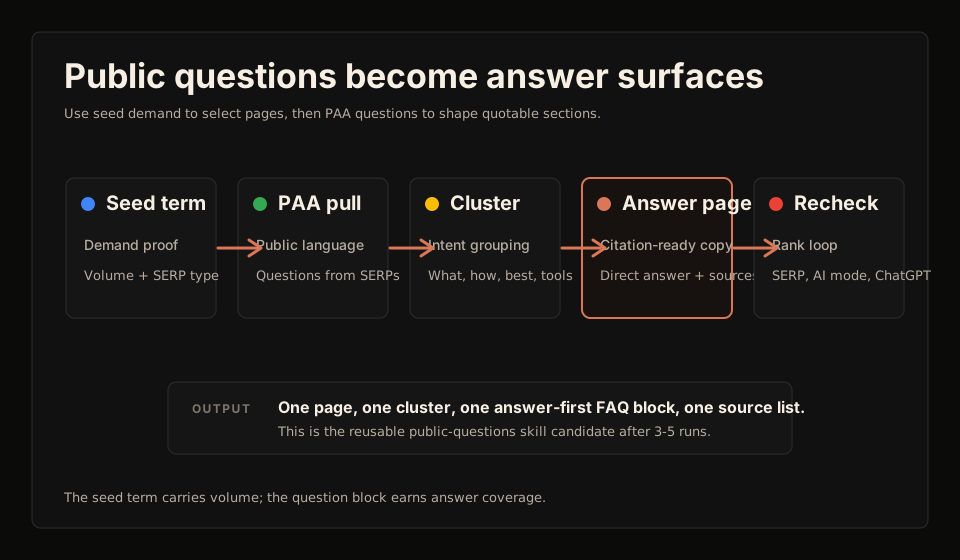
The public-questions workflow turns a high-volume seed keyword into a page structure made from real questions people see in search. It starts with the seed, extracts People Also Ask and related questions, clusters them by intent, and writes answer-first sections that can stand alone as useful passages.
This does not replace normal keyword research. It fixes the gap between keyword tools and actual language. A seed like claude code skills had 9,900 monthly US searches in the same-day DataForSEO evidence pack. Its PAA surface included questions such as "Do skills work in Claude Code?", "What are the best skills for Claude Code?", and "How to give Claude Code a skill?" Those questions are the article sections.
Why exact PAA questions can show zero volume
Long natural-language questions often do not behave like head terms in keyword tools. That does not make them useless. It means the page should rank for the seed term while answering the question variants clearly enough to win snippets, PAA clicks, and AI answer reuse.
| Seed term | Demand signal | Answer surface |
|---|---|---|
ai visibility tool | 1,300 volume, KD 16 | What is the best AI visibility tool? How do I check AI visibility? |
llm visibility tool | 590 volume, KD 18 | What is LLM visibility? How do I track LLM visibility? |
claude code skills | 9,900 volume, KD 32 | Do skills work in Claude Code? How do I give Claude Code a skill? |
answer engine optimization tools | 260 volume, KD 5 | What is AEO vs SEO? How do I optimize for AI search? |
How to build a PAA-led article
- Choose one seed. Pick a term with measurable demand and a clear intent.
- Pull the SERP. Capture PAA questions, related searches, AI Overview presence, and the top competing pages.
- Normalize questions. Remove duplicates and group by definition, comparison, how-to, best/tools, troubleshooting, and commercial intent.
- Write answer-first H2s. Each section starts with a direct 40-80 word answer, then adds proof and steps.
- Add visible sources. Cite official docs or first-hand evidence. Avoid unsupported claims about AI ranking shortcuts.
- Recheck visibility. After publishing, rerun SERP and AI visibility checks for the seed and the question set.
What official guidance supports this?
Google's guidance for AI features points back to strong foundational SEO: make content crawlable, indexable, useful, and eligible for snippets. Google also says structured data should match visible page content. That means the safe public-questions approach is not hidden schema stuffing. It is visible, answer-first content that aligns with the user's real question.
For AI-specific measurement, DataForSEO documents AI Optimization endpoints for LLM responses, ChatGPT scraping, LLM mentions, and Google AI Mode results. Those are measurement inputs. They are not guarantees. They should be logged with query, date, market, and source URLs.
Where this first batch uses public questions
The first AI visibility rank loop uses public questions in three places:
- AI Visibility Tool answers the commercial tool and tracking questions.
- This page explains the PAA method and why a future
public-questionsskill makes sense. - The Claude/Codex skills ecosystem article answers the education wedge around skills, plugins, hooks, and agents.
Frequently asked questions
What is People Also Ask SEO?
People Also Ask SEO is the practice of using the questions Google surfaces around a seed query to structure clearer answers. The page still needs a real keyword target, but the PAA questions reveal how people phrase follow-ups and objections.
Should every PAA question become its own page?
No. Most PAA questions should become sections inside a stronger seed-targeted page. Create separate pages only when the question has distinct intent, enough demand, or a different conversion path.
Can this become a new skill?
Yes, but after repeated runs. The stable skill should accept a seed keyword, pull PAA and keyword evidence, cluster questions, write answer-first blocks, and output schema-ready page briefs. For now, Claude Blog and Claude SEO already cover enough of the workflow to publish the first batch.